
Whether it’s ChatGPT, Siri or a pop-up support widget on an e-commerce site, chances are you’ve interacted with a chatbot recently. These digital assistants are designed to answer questions and automate simple tasks by pulling responses from an AI knowledge base. They’re fast, efficient and useful – but increasingly, they’re starting to show their limits.
Enter AI agents.
These intelligent, goal-driven tools go beyond scripted interactions. Unlike chatbots, AI agents can plan, take actions across systems, make decisions and learn from experiences – all in pursuit of the goals they’ve been set. Instead of simply responding to users, they can independently solve complex, multi-step problems.
In this article, I break down key differences between AI knowledge base chatbots and AI agents, helping you understand how each works, where they shine, and which is better for optimising the customer experience at your organisation.
What is an AI knowledge base chatbot?
An AI knowledge base chatbot is a digital assistant designed to simulate human-like conversations using natural language processing (NLP). Modern versions are powered by AI and used to answer routine customer queries, retrieve information and guide users through simple processes.
Unlike traditional rule-based bots, AI knowledge base chatbots understand user intent more fluidly and generate more natural responses. Typically trained on a specific dataset – FAQs, product documents or help articles, for example – they deliver fast, relevant answers at scale.
However, AI knowledge base chatbots work best within defined parameters. They draw from knowledge bases – smart, interactive repositories that organise and deliver business-critical information. And they’re enriched by large language models (LLMs). However, they lack deeper contextual understanding. Because they can’t reason or act independently, they show their frailties when queries require decisions or fall outside their training scope. Ultimately, they’re limited to static data retrieval rather than autonomous action.
What is an AI agent?
An AI agent is a more advanced form of artificial intelligence that moves beyond scripted answers and static knowledge retrieval. Instead of simply responding to questions, AI agents autonomously pursue goals, make decisions and take action to complete complex tasks.
Built on LLMs, AI agents use sophisticated machine learning and natural language processing to understand and interact with their environment. Rather than simply retrieving information, they solve problems, coordinate workflows, trigger processes, integrate outside data and adapt their strategies over time to achieve a specific goal.
For example, an AI agent in a customer service setting might identify an issue and then initiate a refund, update a CRM system and notify the customer – all without human involvement. Crucially, AI agents handle multi-step, multi-system interactions with minimal supervision.
Ultimately, AI chatbots retrieve answers while AI agents deliver outcomes. This makes them ideal for automating more complex open-ended tasks that require reasoning, memory and dynamic decision making.
AI knowledge base chatbots vs AI agents – Key differences defined
AI knowledge base chatbots and AI agents both use artificial intelligence to enhance digital interactions. However, their capabilities are vastly different – and understanding the differences is crucial when deciding which tool (or combination of tools) is best for your organisation.
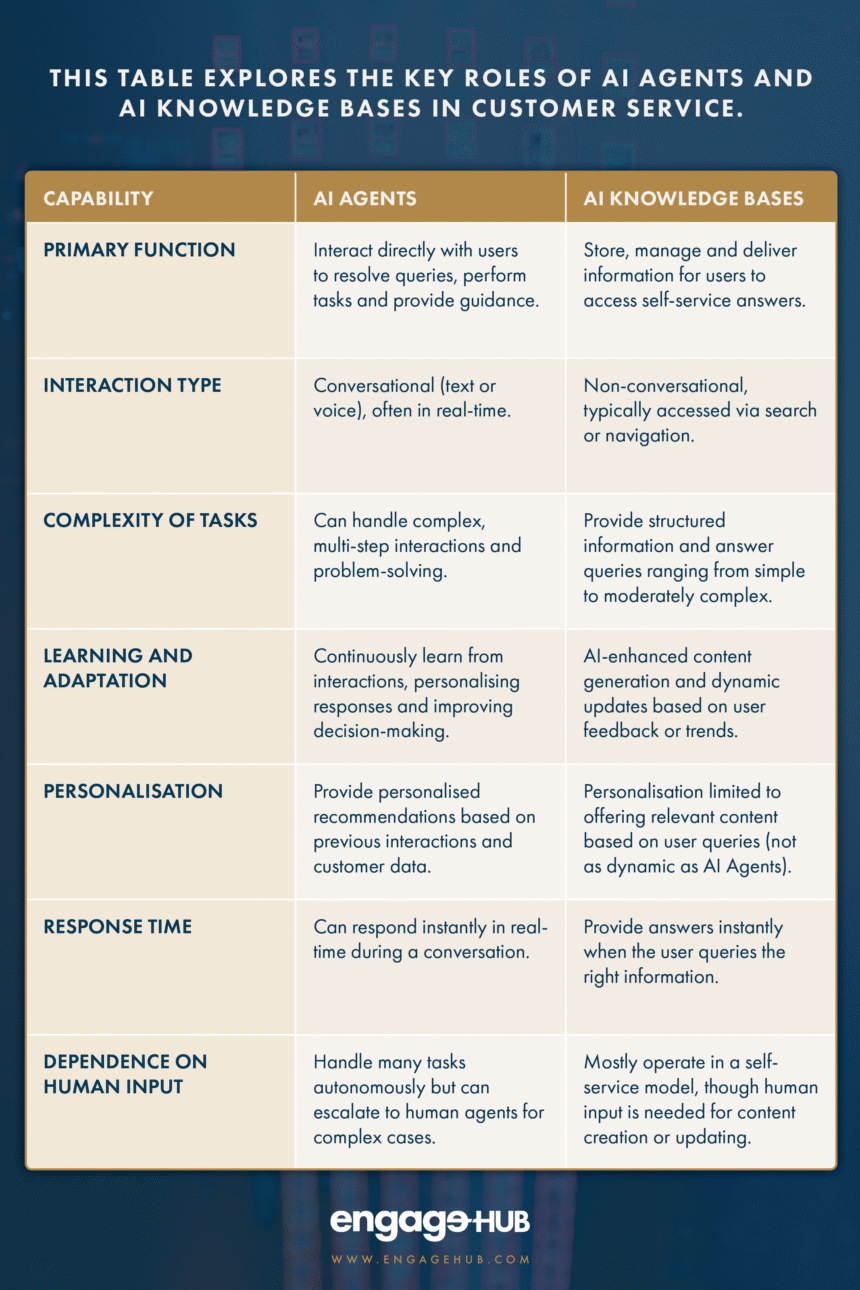
This table summarises the key differences:
AI agent + AI knowledge base chatbot = Supercharged CX
AI knowledge base chatbots and AI agents serve different purposes. By using them together, you’ll unlock their true potential and build a cohesive AI strategy that provides intelligent, scalable customer experiences.
Knowledge base chatbots are ideal for handling high-volume, low-complexity queries – instantly providing answers about your products, services or policies or troubleshooting issues. This frees up capacity and delivers fast results for customers looking for straightforward information.
Meanwhile, AI agents take over when interactions become more complex or require action – for example, if a customer needs to modify a booking, escalate a complaint, or trigger a return.
Together, AI agents and AI chatbots offer 24/7 end-to-end support, from initial query right through to resolution. Improving response times while reducing operational costs and increasing customer satisfaction, this hybrid model ensures customers get the right support while businesses operate more efficiently without compromising quality.
Build seamless customer journeys with AI
As customer expectations rise, businesses need to provide intelligent, outcome-driven experiences. AI knowledge base chatbots and AI agents each play a valuable role in achieving this – from answering routine queries to automating complex, cross-functional tasks. And by combining the speed and consistency of AI knowledge base chatbots with the advanced reasoning and autonomy of AI agents, organisations can build scalable customer service models.
Whether you’re just beginning your AI journey or looking to improve existing systems, understanding how these tools complement each other is key to unlocking long-term value.
Download this whitepaper to learn more about how to take customer service from ordinary to extraordinary with AI-powered customer journeys.
